

Paragraph 1: A Shared Exploration of Human Experience and the Natural World:
The Stockholm gallery scene awakens from its winter slumber, presenting a diverse array of artistic expressions that delve into the human condition and our relationship with nature. Harry Andersson’s ceramic portraits at Saskia Neuman Gallery capture the everyday struggles of existence, echoing the somber atmosphere of January. These small figures, etched with phrases like "Jämmerdal" (Valley of Woe), resonate with a sense of shared experience. Andersson’s work, with its DIY aesthetic and tragicomic sensibility, invites reflection on the human experience. This focus on human experience, albeit expressed in vastly different styles, connects Andersson’s work to other artists exhibiting this season.
Paragraph 2: Threads of Storytelling and Environmental Concern:
Britta Marakatt-Labba’s exquisite embroideries and appliqués at Galleri Helle Knudsen transport viewers to the vast landscapes of the Arctic. Her meticulous stitches depict reindeer, trees, and celestial bodies with an almost pedagogical clarity. Marakatt-Labba’s miniature human figures, mere pinpricks in the expansive scenery, highlight the power of stylized representation. Her works, such as "Rötter" (Roots) and "Gábna" (the name of a Sami village) explore the interconnectedness of life, the blurring of myth and reality, and the looming threat of environmental exploitation. This exploration of the natural world, and humanity’s place within it, finds echoes in other exhibitions.
Paragraph 3: Recycled Realities and the Echoes of Place:
Hans Isaksson’s "New/old" exhibition at Björkholmen Gallery presents an intriguing dialogue with Marakatt-Labba’s themes, though through a distinct conceptual lens. His collages, incorporating found objects and recycled materials, speak to the cyclical nature of creation. Isaksson transforms discarded objects – orange peels become suns, the innards of footballs resemble honeycombs – infusing them with new meaning. His work "Spår" (Traces), a life-sized painting supported by wooden clogs, evokes the interconnectedness of humanity and nature, a theme resonating with both Andersson’s intimate portraits and Marakatt-Labba’s expansive landscapes. This resourcefulness and focus on natural materials further underscore the shared concern for the environment.
Paragraph 4: Vibrant Warnings and Contemplative Reflections:
A shift in color palette marks a departure from the earthy tones of the previous exhibitions. Carl Boutard’s bold drawings at Cecilia Hillström Gallery employ vibrant hues of green, yellow, and orange to depict the delicate forms of dried leaves. The title of his exhibition, "Degrowth," hints at the underlying message of environmental awareness. Boutard’s meticulously rendered leaves, inspired by his observations in Iceland and earlier works from Malmö, invite reflection on the cycle of life and decay. This exploration of nature’s fragility continues the dialogue established by Marakatt-Labba and Isaksson, but with a more direct and visually arresting approach.
Paragraph 5: Explosions of Color and Emotional Landscapes:
Ludvig Helin’s energetic paintings at GSA Gallery mark another shift in artistic style. His canvases pulsate with contrasting colors and forms, revealing a more free-flowing and process-oriented approach. While Helin’s work is predominantly abstract, landscapes emerge as an underlying theme, echoing Marakatt-Labba’s depictions of the natural world. In his work "Apans sång #3" (The Monkey’s Song #3), the interplay of two orbs suggests a mirroring effect, a visual echo of the interconnectedness explored in other exhibitions. Helin’s intuitive and explorative approach stands in contrast to the more meticulously planned works of some of his contemporaries, but the shared interest in exploring inner and outer worlds remains a connecting thread.
Paragraph 6: Constructed Worlds and Symbolic Narratives:
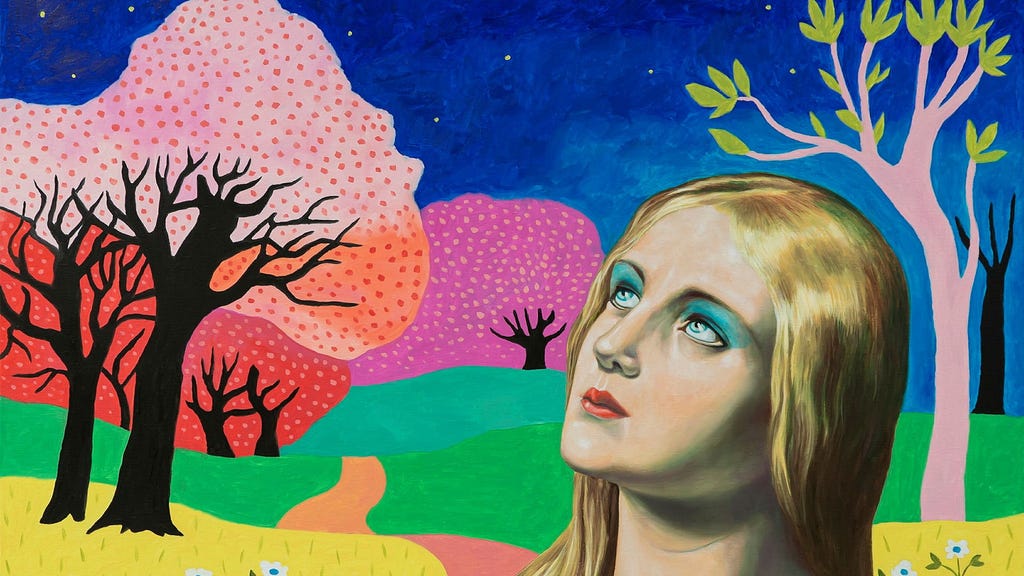
Finally, Martin Jacobson’s exhibition "Porträtt och siluetter" (Portraits and Silhouettes) at Andréhn-Schiptjenko presents a meticulously constructed world of symbolic imagery. His paintings juxtapose hyperrealistic figures with dreamlike backdrops, creating a sense of disconnect and surrealism. In "11 flowers, 11 stars," a young woman gazes upward, her dreamy expression echoing the introspective figures in Andersson’s ceramic works. Jacobson’s use of vibrant colors and theatrical compositions provides a stark contrast to the more grounded palettes of other exhibitions. However, his exploration of the human figure within a constructed environment adds another layer to the season’s overarching themes of individual experience, the natural world, and the search for meaning. Across the various exhibitions, the Stockholm gallery scene offers a rich tapestry of artistic expression, prompting viewers to contemplate their own place within the world and the interconnectedness of all things.