



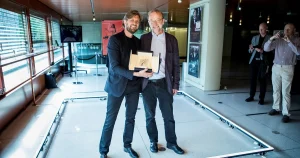




Gothenburg Book Fair, one of northern Europe’s most important literary venues, once again became a site for political remembrance. For the third consecutive year, the action group Bread and Roses was present to honour the journalists who have been killed in Gaza. Their presence, low-key but deliberate, wove together literature, war, and press freedom in a way that underscored the increasingly fragile conditions for media workers in conflict zones.
The Gothenburg Book Fair, held annually at the Swedish Exhibition Centre, is more than a marketplace for books. It is a stage for cultural debate, where publishers, authors, and readers gather to discuss everything from poetry to global politics. In recent years, the fair has also become a place where human rights issues are brought to the foreground. Bread and Roses, a self-described action group known for feminist and solidarity campaigns, has chosen to use this platform to draw attention to the situation of Palestinian journalists. Their action is not only a tribute to the dead, but a reminder of the ongoing dangers faced by reporters still working in the Gaza Strip.
The decision to return to the fair for a third year signals a persistent sense of urgency. Since the outbreak of the war in Gaza, the toll on journalists has been staggering. International press freedom organisations have repeatedly pointed out that the conflict has become one of the deadliest ever for media workers. Local reporters have been killed in airstrikes while covering their own communities, and others have lost their lives along with their families. Those who survive face severe restrictions, lack of food and fuel, and a constant threat of further violence. The names of the slain journalists, now far too numerous to read aloud in a single moment, have become a grim litany of the war’s broader human cost.
Bread and Roses did not come to the book fair to stage a dramatic protest. Their method appears to be quieter, more symbolic. Visitors may have encountered members of the group holding posters with names, or engaging visitors in conversation about press freedom. Whether through a minute of silence, a roll call of the deceased, or simply a persistent presence in the exhibition halls, the group’s message was clear: the world must not look away. By situating their tribute inside a cultural institution, they also ask the literary community to reflect on its own responsibility. Publishing houses, journalists, and writers in Sweden are part of a global network of storytellers. When one colleague is silenced, the story itself is threatened.
The fair’s significance in this context should not be underestimated. With thousands of visitors each day, including school classes, librarians, and international media, the event offers a rare opportunity to reach a broad audience. The halls are filled with stalls for major Nordic publishers, but also smaller independent presses and non-governmental organisations. It is in this crowded, noisy environment that political messages can gain an unexpected resonance. A memorial initiative can travel further when it is shared between book signings and panel discussions.
The actions of Bread and Roses also reflect a wider trend within Swedish cultural life: a growing willingness to engage with global conflicts from a moral and journalistic standpoint. Book fairs, literary festivals, and similar events have increasingly become spaces where boycott debates, freedom of speech issues, and solidarity campaigns are raised. This development is not without controversy. Some critics argue that cultural events should remain separate from political activism, while others maintain that silence in the face of suffering is itself a political stance. The Gothenburg Book Fair, with its long history of debate and scandal, seems to have chosen the latter interpretation. By allowing Bread and Roses to return, the fair implicitly recognises that literature and politics cannot always be easily separated.
For the journalists still alive in Gaza, the international attention matters even if it cannot protect them directly. Every report, every awarded press freedom prize, and every mention of their names helps to counter the narrative that their deaths are simply an acceptable part of war. The action at the book fair is thus a small but tangible contribution to a much larger global effort to document the toll on press freedom. It is a way of saying that these reporters were not faceless victims. They were fathers, mothers, poets, and local correspondents who wanted to bear witness.
As the fair’s doors close for another year, the memorial to Gaza’s journalists will disappear from the exhibition floor. But the memory of the action, and of the names behind it, lingers in the conversations carried home by visitors. Bread and Roses has announced no plans to stop coming. As long as journalists continue to die in armed conflicts, the group insists, acts of remembrance will be needed. For now, that means returning to Gothenburg, year after year, to honour the fallen and to remind the world that every silenced voice diminishes us all.
20 kommentarer
Uranium names keep pushing higher—supply still tight into 2026.
I like the balance sheet here—less leverage than peers.
Exploration results look promising, but permitting will be the key risk.
If AISC keeps dropping, this becomes investable for me.
Good point. Watching costs and grades closely.
Good point. Watching costs and grades closely.
Production mix shifting toward Nyheter might help margins if metals stay firm.
Good point. Watching costs and grades closely.
Good point. Watching costs and grades closely.
Nice to see insider buying—usually a good signal in this space.
Production mix shifting toward Nyheter might help margins if metals stay firm.
Good point. Watching costs and grades closely.
Good point. Watching costs and grades closely.
The cost guidance is better than expected. If they deliver, the stock could rerate.
Good point. Watching costs and grades closely.
Nice to see insider buying—usually a good signal in this space.
Good point. Watching costs and grades closely.
Good point. Watching costs and grades closely.
Silver leverage is strong here; beta cuts both ways though.
Good point. Watching costs and grades closely.