



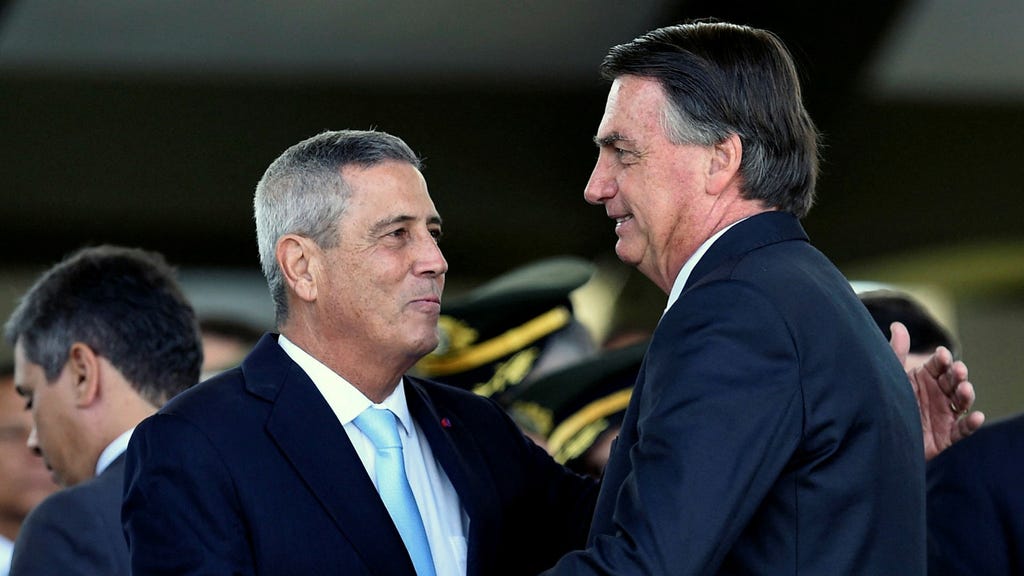
The arrest of General Walter Braga Netto in Rio de Janeiro has significantly escalated the political turmoil surrounding former President Jair Bolsonaro and the attempted coup d’état on January 8, 2023. Braga Netto, who served as Bolsonaro’s Chief of Staff and Defense Minister, was apprehended at his home and taken to a military prison. Simultaneously, federal police conducted searches at various addresses linked to him, including the residence of a reserve colonel who served as his aide during Bolsonaro’s presidency. The arrest warrant issued by a Supreme Court judge followed revelations from a key witness, Lieutenant Colonel Mauro Cid, Bolsonaro’s former aide, implicating Braga Netto in the coup plot.
The federal police allege Braga Netto played a central role in a network of high-ranking officers who supported and coordinated efforts to overturn the 2022 election results and prevent Luiz Inácio Lula da Silva from assuming the presidency. The investigation suggests Braga Netto orchestrated a meeting between Bolsonaro and the former army commander in late 2022, seeking military backing for the coup. Furthermore, he is accused of attempting to silence Cid, who has been cooperating with authorities in exchange for a reduced sentence. Cid’s testimony, corroborated by recovered documents and chat messages, has been instrumental in exposing the alleged involvement of Bolsonaro and military figures in the coup attempt.
The arrest of Braga Netto places Bolsonaro, who was formally charged with involvement in the coup attempt just three weeks prior, in an increasingly precarious position. The federal police contend that Bolsonaro actively participated in the events of January 8th, when thousands of his supporters stormed the presidential palace, Congress, and the Supreme Court. The investigation concludes that the coup failed due to ”circumstances beyond his control.” Bolsonaro, however, denies the accusations, attributing them to political persecution by a Supreme Court judge.
In a surprising twist, Bolsonaro’s defense team has recently posited a counter-narrative, suggesting that the coup attempt was orchestrated by the military without Bolsonaro’s knowledge or consent. They claim that figures like Braga Netto harbored ambitions of establishing a military dictatorship, independent of Bolsonaro’s leadership. This strategy, however, appears to have backfired, creating a rift between Bolsonaro and the military, potentially jeopardizing his crucial base of support. The emerging divisions within the right-wing alliance could significantly weaken Bolsonaro’s political standing and influence.
The January 8th coup attempt unfolded against a backdrop of escalating political tensions and disinformation campaigns targeting the integrity of Brazil’s electoral system. Bolsonaro, who had repeatedly sown doubts about the validity of the election process, refused to concede defeat to Lula. This rhetoric fueled a climate of distrust and animosity, culminating in the violent assault on democratic institutions. The events of January 8th deeply shook Brazilian democracy, raising concerns about the resurgence of authoritarianism and the erosion of democratic norms.
The ongoing investigations and legal proceedings related to the coup attempt represent a crucial test for Brazil’s democratic institutions. The arrests of prominent figures like Braga Netto, and the formal charges against Bolsonaro, signal a commitment to holding those responsible accountable. The outcome of these proceedings will have far-reaching implications for the future of Brazilian politics, determining whether the country can successfully navigate this turbulent period and reaffirm its commitment to democratic governance. Furthermore, the erosion of Bolsonaro’s support within the military, a traditionally powerful force in Brazilian politics, signifies a potential shift in the political landscape, with implications for future elections and the balance of power. Bolsonaro’s disqualification from the 2026 presidential race due to his dissemination of election misinformation adds another layer of complexity to the political scene, creating further uncertainty about the country’s political trajectory.