




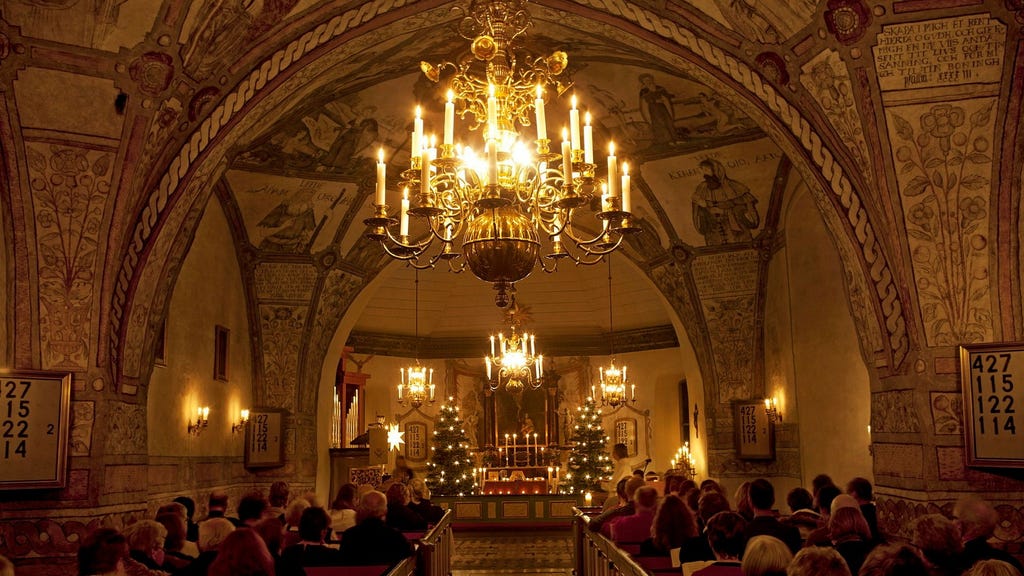
The quiet solace of a church pew drew the author, a self-proclaimed non-believer, into Gustaf Vasa kyrka. Seeking a moment of spiritual respite, a need increasingly felt in recent years, she found herself amongst others who seemed to share this yearning. Reports of rising membership in the Swedish Church and prime-time discussions about God’s existence underscored this growing spiritual hunger. While not a believer herself, the author felt drawn to the church as a repository of human experience, a place where life’s milestones – baptisms, weddings, funerals – resonated within the very walls. She recognized that some might find her presence in the church inappropriate, yet for her, the concept of God transcended such narrow interpretations. The church represented a connection to something larger, a shared human experience that stretched across generations.
The televised debate about God’s existence, featuring theologian Joel Halldorf, highlighted the intertwined nature of religion and culture. This resonated deeply with the author, who found the texts of the church interwoven with the literature that shaped her life – novels, short stories, and poems. These diverse voices combined to create a rich tapestry of human experience, echoing the sentiments of Viktor Rydberg’s classic Christmas hymn, ”Gläns över sjö och strand” (Shine over sea and shore). This intermingling of religious and secular texts formed a personal ”chorus of voices,” enriching her understanding of the world and her place within it.
From childhood, hymns held a particular significance for the author. ”Morgon mellan fjällen” (Morning Between the Mountains), although geographically incongruous with her flat northern village, resonated deeply. She reimagined the hymn’s imagery, mapping the ”beck and river gurgling against the rock” onto her local landscape, the Ångerman River and the small stream near her home. This personal interpretation grounded the hymn, connecting it to her own life and surroundings. The hymns became a way to understand and articulate her experiences, a language for the emotions and experiences that shaped her life’s journey.
Raised in an atheist family of writers, the author’s background was devoid of traditional religious practices. She wasn’t baptized or confirmed and opted for a civil marriage. Despite this secular upbringing, her connection to the church was complex. At twenty, she left the church, only to return during the 2015 refugee crisis. This return was driven by a desire to align herself with an institution that championed compassion and aid for those in need. It was a demonstration of her belief in the church’s social responsibility, a value that superseded doctrinal adherence.
Her father, a priest’s son, vehemently rejected his religious upbringing, embracing a life rooted in the concrete and sensual. He despised metaphysics, choosing instead to focus on the tangible world. Yet, the author recognized the indelible mark of religious language on her father’s poetic voice. His most powerful verses possessed a psalm-like quality, hinting at the enduring influence of his childhood. This influence became even more apparent during times of grief. When her mother faced a terminal illness, both father and daughter found solace in the language of faith, a surprising turn for the staunch atheist.
As her mother’s health deteriorated, the author and her father shared a moment of profound vulnerability. Overwhelmed by grief and a sense of impending loss, the author found herself reciting lines from the hymn ”Bred dina vida vingar” (Spread Your Wide Wings), a prayer for comfort and protection. To her astonishment, her atheist father echoed her sentiment, acknowledging his own need for solace in that dark hour. The shared language of faith, even for those who did not believe, provided a framework for expressing the inexpressible, a way to navigate the overwhelming emotions of grief and loss. The hymn acted as a bridge, connecting them to a shared human experience that transcended their individual beliefs.
The shared experience of reciting the hymn offered solace and connection. Grief tends to isolate, but the words of the hymn, echoing the experiences of countless others, reaffirmed their shared humanity. This resonated with the author’s overall experience with literature and hymns, which she viewed as a continuous stream of voices across millennia. The contributions of individuals throughout history, expressing their joys, sorrows, doubts, and dreams, created a chorus of human experience. Participating in this ongoing dialogue, whether through reading, listening, or reciting, provided a sense of belonging and connection to something larger than oneself. While not equating this with God, the author recognized its profound spiritual significance, a connection to the shared human story that resonated deeply within her.