









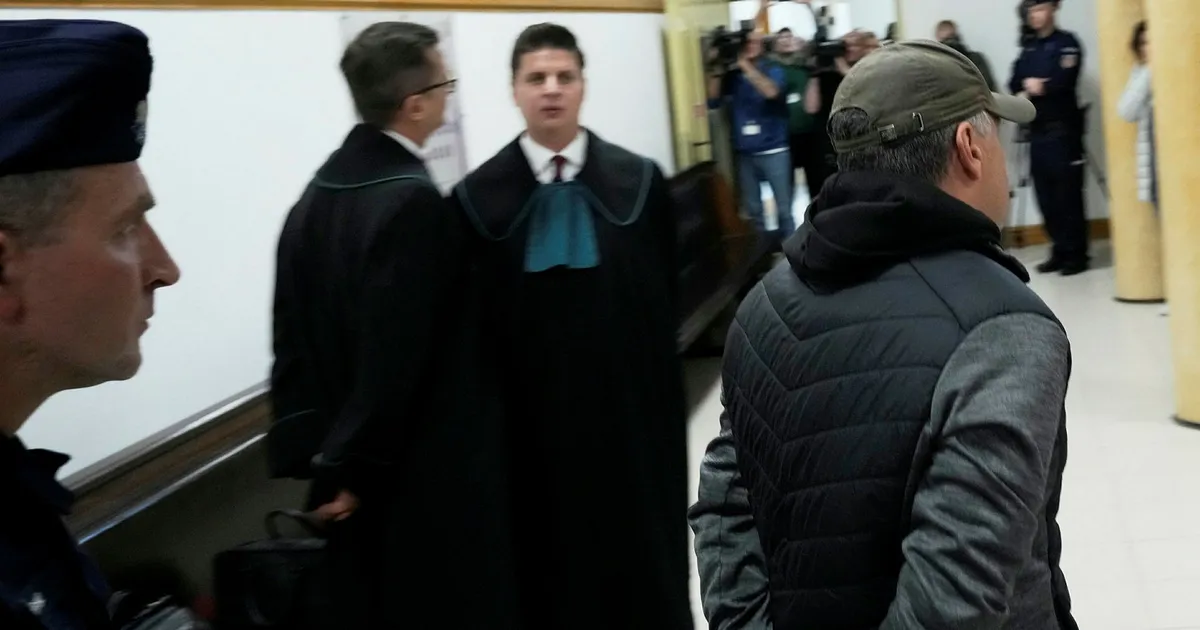
I veckan greps en ukrainsk man i den kroatiska kuststaden Pula, efter att Tyskland hade utfärdat en europeisk arresteringsorder mot honom. Han är misstänkt för delaktighet in sprängningarna av gasledningarna Nord Stream i Östersjön in September 2022, ett sabotaget that has grown into one of the most politically sensitive criminal cases in Europe since Russia’s full-scale invasion of Ukraine.
The arrest was made at the same time as the man was in Pula as an expert during the filming of the upcoming Hollywood film ”Snake Island”, a production about exactly this sabotage. The film’s director is Doug Liman, known for Jason Bourne films, and Sean Penn and Adrien Brody are on the cast list. The motifs that the real world and a dramatized version of the same event now meet in a small Adriatic town have been noticed by German media.
The German federal prosecutor’s office confirmed that the Ukrainian citizen was arrested after a European Arrest Warrant was issued. The warrant is one of the EU’s most important legal instruments to strengthen cooperation, allowing the judicial authorities of a member state to request the arrest and extradition of a suspected person from another member state. It does not require a political decision, and the country where the person is arrested must, normally, execute the order.
The man who was now arrested in Pula had previously been arrested in Poland. There he sat in exile, but was later released despite Germany’s repeal of extradition. The Polish, who has increasingly come to see Russia’s full invasion as a threat to the entire European continent, has explained their position by saying that a possible Ukrainian attack against the pipeline could not be considered a crime, but rather a legitimate action in an armed defensive war. That statement has been interpreted as a direct acknowledgment that Polish authorities refused to cooperate in a case that is considered sensitive in direct relation to Ukraine’s warfare against itself.
Another Ukrainian man suspected of participation in the sabotage was arrested in Italy last year and extradited to Germany. Both denied any involvement in the operation. Ukrainian President Volodymyr Zelensky has also denied that the Ukrainian government has ordered or been aware of the attack.
The case is far more than a criminal search. The sabotaged gas pipelines were not only infrastructure, but symbols of Europe’s dependency on Russian energy. The Nord Stream 1 pipeline, which was in use since 2011, is owned mostly by several European energy companies, but the Russian gas giant Gazprom still controls 51 percent. Nord Stream 2, built via a consortium fully controlled by Gazprom, was completed shortly before the invasion and had never been in operation when the four pipe storage units were found on September 26, 2022. Seismic measuring stations registered unexpected shocks in the area at 02:03 and 19:03 the same day.
The recordings occurred only months after the beginning of the large-scale invasion, and they became a turning point for European energy policy. Before the attack, Germany and several other EU states were still partly dependent on Russian gas. After the sabotage, no road was rebuilt, and the pipelines remain buffered. The event accelerated the EU’s broader effort to phase out Russian fossil income and has given the line a broader once again. But the political significance is now deeper: a rift in the interpretation between a former socialist state and German prosecutors shows how Ukraine’s defense rights and EU energy independence can collide with legal and diplomatic ties.
For the region, the Baltic Sea around Bornholm has also become a center of international military and energy tension. The Danish island’s cliffs have become a area through which several surveillance and assessment of pipelines and underwater cables now happen. The international interest in underwater infrastructure security has increased sharply after the incidents of September 2022. German prosecutors are building part of their case on evidence collected from the site, which they have described as an underwater scene with documented traces of postponed changes.
The legal process now continues. The man arrested in Pula will be handed over to Germany in the same way as the one who was extradited from Italy. Both suspected divers deny the allegations, and the Ukrainian leadership stands by its denial. However, the crimination of the comprehensive, Europe is now being questioned of what must be done to handle both the sovereign law inheritance and the consequences of an armed attack in the region. The case has become a dilemma: the countries that support Ukraine’s war efforts must also deal with the possibility that Ukraine’s secret actions outside its own territory could be caught up in legal suspicions. In that sense, the images in ”Snake Island”… The film of the event has not premiered, but reality has already delivered its own plot – and its first act has ended in a Croatian court, far from the Hollywood sound studios.








9 kommentarer
Exploration results look promising, but permitting will be the key risk.
Good point. Watching costs and grades closely.
The cost guidance is better than expected. If they deliver, the stock could rerate.
Production mix shifting toward Världen might help margins if metals stay firm.
Good point. Watching costs and grades closely.
If AISC keeps dropping, this becomes investable for me.
The cost guidance is better than expected. If they deliver, the stock could rerate.
Good point. Watching costs and grades closely.
Good point. Watching costs and grades closely.