


Gunilla Klingberg stands as a pivotal figure in the nascent history of 21st-century Swedish public art. Her post-industrial visual enigmas, characterized by the intricate repetition of logos and symbols into expansive mandala-like patterns, resemble contemporary hieroglyphs, effectively communicating their message regardless of their location. These works, imbued with both spiritual and commercial allusions, simultaneously embody accessibility and enigma, flexibility and detail, decorative appeal and subtle subversion. Escaping the confines of such a successful formula presents a significant artistic challenge. The Skissernas Museum in Lund showcases Klingberg’s evolution towards a more site-specific expression in two new large-scale Stockholm projects, demonstrating her departure from simply projecting interchangeable contemporary symbols onto surfaces.
The exhibition focuses on two of Klingberg’s recent projects: ”Whirlwind” (Virvelvind) at Sergels Torg, completed in 2021, and ”The Red Thread” (Den röda tråden), a large-scale installation for the new Slussen bus terminal, slated for inauguration in 2025. Both works engage with their respective locations not merely as blank canvases for contemporary iconography, but as repositories of collective memory, albeit through distinct approaches. ”The Red Thread,” in particular, holds immense promise. While awaiting the unveiling of the finished piece, one can only imagine the magnificent tapestry unfolding across the terminal floor, embedded within Katarinaberget behind Slussen. The exhibition offers a tantalizing glimpse into the intricate planning and design process behind this ambitious undertaking.
Klingberg grounds ”The Red Thread” in the rich textile industrial heritage that shaped Södermalm a century and a half ago, when the area thrived with countless small workshops and weaving mills. Today, only one remains: Almgrens sidenväveri on Tjärhovsgatan. Klingberg draws inspiration from one of their shawl patterns for the sinuous, pleated weave that will adorn the terminal’s floor tiles, creating a grand yet subtly integrated monument to a vibrant, predominantly female-driven industrial craft. This connection to local history imbues the artwork with a sense of place and continuity, weaving together the past and the present. The exhibition at Skissernas Museum provides further insight into this connection through preparatory sketches and materials.
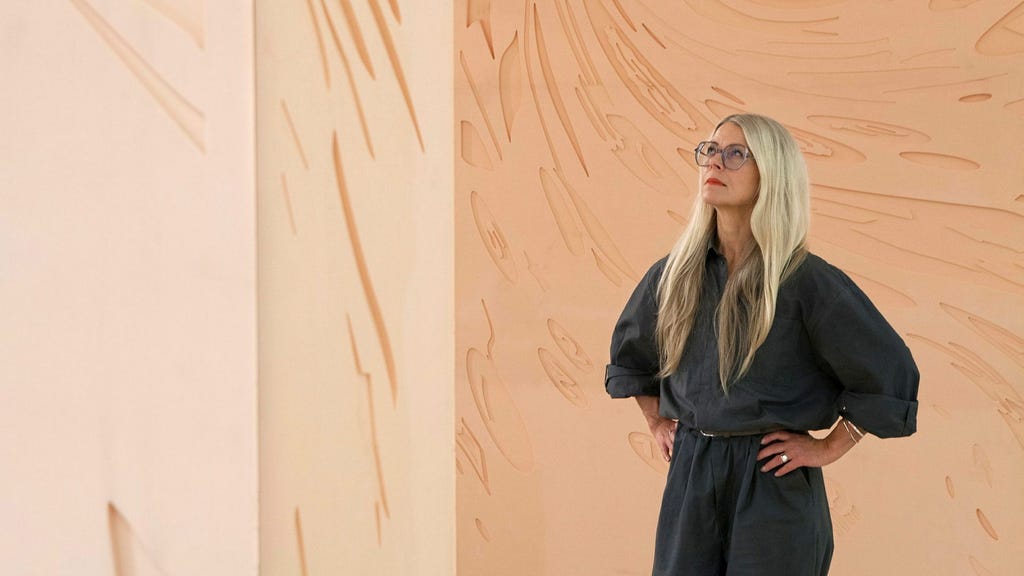
In contrast to the sprawling ambition of ”The Red Thread,” ”Whirlwind” at Sergels Torg adopts a lighter, more unassuming approach. Its design, etched into the pavilion’s red concrete facade, features a swirling pattern of balloons, tickets, banners, and other ephemeral remnants of recent history. While appearing relatively modest in its original context, ”Whirlwind” takes center stage at the Skissernas Museum. The exhibition displays the original casting molds of the pavilion walls, transforming them into a commanding portal leading to a detailed, albeit somewhat dry, presentation of the material and pattern solutions for the Slussen terminal project. The museum setting amplifies the presence of ”Whirlwind,” allowing viewers to appreciate its intricate details and conceptual underpinnings.
The exhibition effectively contrasts these two projects. The sheer scale and historical grounding of ”The Red Thread” stand in juxtaposition to the more ephemeral and playful nature of ”Whirlwind.” The museum context allows for a deeper engagement with both projects, offering insights into Klingberg’s artistic process and the conceptual frameworks driving her work. While the presentation of the Slussen project might appear somewhat technical to the average visitor, it provides a valuable glimpse into the complex considerations involved in large-scale public art installations. The exhibition demonstrates Klingberg’s ability to adapt her artistic language to diverse contexts, creating works that resonate with their specific locations while maintaining her signature blend of visual complexity and conceptual depth.
Overall, the exhibition at the Skissernas Museum offers a compelling exploration of Gunilla Klingberg’s recent work, highlighting her shift towards site-specific installations that engage with the history and context of their locations. While ”The Red Thread” remains largely anticipatory, its potential impact is palpable through the preparatory materials and descriptions. ”Whirlwind,” on the other hand, is presented in a new light, its intricate details and conceptual underpinnings brought to the forefront. The exhibition serves as a testament to Klingberg’s ongoing artistic evolution and her significant contribution to contemporary public art, prompting reflection on the interplay between art, history, and urban space. It also provides valuable insight into the process of creating large-scale public art, from initial concept to material selection and final execution. Though perhaps not immediately accessible to all audiences, the exhibition rewards patient observation and offers a fascinating look at an artist pushing the boundaries of her practice.